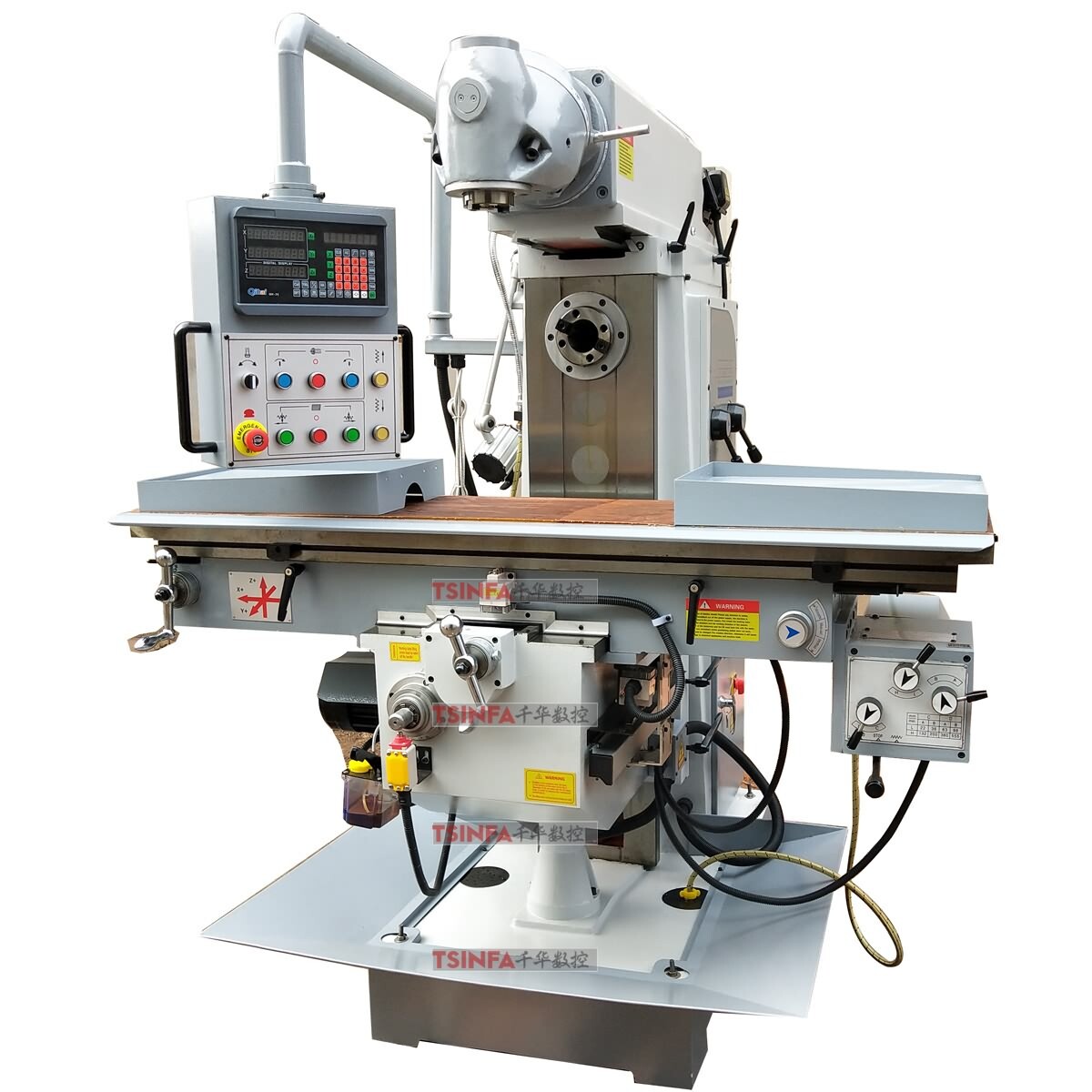
What is 240V milling machine?
240V milling machine is a machine tool for milling workpiece with milling cutter. Milling machine in addition to milling plane, groove, gear, thread and spline shaft, but also processing more complex surface, the efficiency is higher than planer, in machinery manufacturing and repair departments have been widely used. Universal milling machines usually use three-phase power supply, and the voltage can be set according to the actual use of customers to meet the use of customers in different countries and regions. Please tell our salesperson the specific power requirements before purchasing, and we will provide you with the most suitable milling machine.
Is milling cutter important to milling machine?
Milling cutter is very important for milling machine. It directly affects the service life of the milling machine and the machining quality of the workpiece. Ideally, the diameter of the milling cutter should be larger than the width of the workpiece, and the axis line of the milling cutter should always be slightly away from the centerline of the workpiece. When the tool is placed directly against the cutting center, burr is easy to occur. When the cutting edge enters and exits the cutting, the direction of the radial cutting force will continue to change, the machine tool spindle may vibrate and damage, the blade may break, and the machining surface will be very rough. The milling cutter will deviate slightly from the center, and the direction of the cutting force will no longer fluctuate – the milling cutter will obtain a preload. Every time the milling cutter blade enters the cutting, the cutting edge must bear the impact load, and the load depends on the cross-section of the chip, the workpiece material and the cutting type. When cutting in and cutting out, whether the cutting edge can bite correctly with the workpiece is an important direction.
When the axis line of the milling cutter is completely outside the width of the workpiece, the impact force during cutting is borne by the tool tip on the outermost side of the blade, which means that the initial impact load is borne by the most sensitive part of the cutter. Finally, the milling cutter leaves the workpiece with the tool tip, that is, from the beginning of cutting to leaving, the cutting force always acts on the outermost tool tip until the impact force is unloaded. When the center line of the milling cutter is just on the edge line of the workpiece, when the chip thickness reaches the maximum, the blade disengages from cutting, and the impact load reaches the maximum when cutting in and out. When the axis line of the milling cutter is within the width of the workpiece, the initial impact load during cutting is borne by the part far away from the most sensitive tool tip along the cutting edge, and the blade exits the cutting smoothly during tool withdrawal.
For each blade, the way the cutting edge leaves the workpiece is important when you want to exit the cutting. The remaining material may reduce the blade clearance when approaching retraction. When it is separated from the workpiece, an instantaneous tensile force will be generated along the rake face of the blade, and burrs are often generated on the workpiece. This tensile force endangers the safety of the cutting edge in dangerous situations. Therefore, we should always pay attention to the situation of milling cutter in operation.
What are the classifications and uses of milling cutters?
The cutters used for plane milling include insert end milling cutter, sleeve end milling cutter, cylindrical milling cutter, three face edge milling cutter and end milling cutter.
- Cylindrical milling cutter: it is divided into coarse teeth and fine teeth. It is generally used for horizontal milling machines and is made of high-speed steel materials. It is commonly used for rough milling and semi finish milling of plane.
- End milling cutter: integral type, insert type and indexable type. It is mainly used for machining plane on vertical milling machine. It can also be used for horizontal milling machines. Generally, the cutter teeth are made of cemented carbide,
- End milling cutter: suitable for smaller planes.
- Three edge milling cutter: suitable for machining small planes